
We Did It Sir David, We Did It: The Music Man Project in New York (Part 1)

PART 1: Against All the Odds
October 7th, 2026.
I take a deep breath as I stand on the stage of New York's iconic Town Hall, as the audience looks on in anticipation. This is the legendary Hall for All, where the phrase "not a bad seat in the house" was born. A theatre steeped in history, renowned for championing the suffragette movement, breaking down racial barriers and giving a platform to those whom society had too often marginalised.
And now, more than a century after its opening, this extraordinary venue was making history once again. For the first time, an international group of musicians with learning and developmental disabilities had brought an original musical theatre production to a Broadway stage – all the way from the UK. The Music Man Project had arrived in New York.
But I wasn't thinking about the history of the theatre, the significance of our achievement or all the people watching me. I was thinking about one man.
Holding the same megaphone Sir David Amess used throughout his life, I looked up to the heavens to salute a dear friend, whose unwavering belief in The Music Man Project had helped make this seemingly impossible dream a reality. Glancing back at his megaphone I said my most important line.
"Well, Sir David, we said we'd take them to Broadway. We did it, my friend. We did it…"
It was a heartfelt and poignant moment of my original musical “Music is Magic on Broadway: The Story of The Music Man Project” and of The Music Man Project's entire groundbreaking New York adventure. An adventure that had tested me like nothing before in my 27-year career. It was the most ambitious, the most expensive, the riskiest and, without question, the most emotional undertaking of my life.
Less than 24 hours later, our extraordinary musicians would perform at the United Nations, where I would deliver a speech calling for a world in which musical opportunity is determined not by disability, but by talent, ambition and the simple right to be included.
Together, these two extraordinary days represented far more than the culmination of a dream. They marked the beginning of a new chapter, not just for The Music Man Project, but for a cause that has defined my life's work for more than a quarter of a century.
Yet, for all the groundbreaking firsts, the standing ovations and the unforgettable memories, our spectacular New York tour in memory of Sir David Amess almost never happened!
Just two weeks before we were due to fly to New York, I received the worst email imaginable.
Our flights had been cancelled!
Eighteen months of relentless fundraising (which would ultimately earn me a Pride of Britain Award for Fundraiser of the Year), countless meetings, meticulous planning, hotel reservations, theatre bookings, coach transfers and arrangements involving dozens of organisations on both sides of the Atlantic were all suddenly thrown into chaos by an email from our airline, Norse Atlantic. We were informed that our outbound and return flights would need to be rescheduled due to "rising fuel costs".
For an ordinary holiday, this would have been inconvenient. For The Music Man Project, it was potentially catastrophic. We were travelling with a party of around 60 people, including 16 musicians with learning disabilities, their families, carers, musicians and support team. Every element of the tour had been carefully coordinated around our arrival and departure dates. Changing those dates simply wasn't an option.
And there was no Plan B. At least, not one I could see. For 12 agonising hours, I genuinely feared that everything we had worked towards for so long might collapse before we had even left the country.
After 27 years of overcoming obstacles, challenging expectations and refusing to accept that something couldn't be done, I suddenly found myself facing a challenge that felt almost impossible to overcome.
How on earth were we going to get 60 people to New York?
There was only one possible solution. We had to find alternative flights, on the same dates, for everyone. Not the following day. Not a day earlier. The entire New York tour had been planned down to the smallest detail, and changing our travel dates would have created an impossible domino effect of additional costs, logistical complications and disrupted arrangements.
But finding 60 available seats to New York at such short notice was no small task. And finding another 60 seats to bring everyone home was equally challenging. After hours of frantic searching, phone calls and negotiations, a solution finally emerged. We could fly to New York with Virgin Atlantic and return home with British Airways.
There was just one rather significant problem: the price.
Our original flights with Norse Atlantic had cost £22,465.98. The replacement flights would cost an eye-watering £71,855.40. That's almost £50,000 more than we had originally paid!
After spending 18 months raising £150,000 to make the Broadway dream possible, we were suddenly facing an additional bill equivalent to almost a third of our entire fundraising target. Money we simply didn't have to spare.
I could scarcely believe what was happening. We had overcome so many obstacles to get this far. We had persuaded supporters, sponsors and complete strangers to believe in our dream. We had booked an iconic Broadway theatre, assembled an extraordinary company of performers and created an international celebration of accessible music. Now, with the finishing line almost in sight, everything was hanging in the balance because of an airline cancellation.
Norse Atlantic eventually agreed to reimburse the additional £49,389.42, but there was a catch. We had to find the money to pay for the replacement flights ourselves, with no certainty about when we would receive it back. It was an enormous financial risk for a small charity that had spent 18 months raising every penny needed to make this dream possible.
But what choice did we have?
As I write this, three weeks after our triumphant Broadway debut, we are still waiting for that almost £50,000 to be repaid.
The performances may be over, the standing ovations may have faded and our musicians may be safely home, but the financial consequences of that dreadful email are still very much with us.
Yet, despite everything, there was something I knew with absolute certainty. I could not look into the faces of our 16 Global Ambassadors, who had rehearsed for two years and dreamed of performing on Broadway, and tell them that we weren't going. Not now. Not after everything they had achieved. I couldn't let Sir David down.
We were going to New York. Whatever it took.
The Challenge of Filling the Hall
If getting 60 people to New York was one enormous challenge, there was another that had been keeping me awake at night for months.
How on earth were we going to fill the Town Hall?
Back home, The Music Man Project had sold thousands of tickets for our spectacular concerts at the Royal Albert Hall. We had built a loyal following, established a national reputation and performed alongside some of the biggest names in music.
But New York was different.
In a city overflowing with world-class entertainment, Broadway productions and internationally renowned performers, The Music Man Project was almost completely unknown. I had rather naively assumed that the sheer novelty of our Broadway debut, and the extraordinary achievements of our musicians, would be enough to attract an audience.
I was wrong.
Despite months of promotion, our ticket sales were languishing at around 80 seats. The Town Hall had a capacity of approximately 1,500. We had barely scratched the surface.
And it certainly wasn't for the want of trying. With the support of our charity trustees, I had travelled to New York in July for a reconnaissance visit, determined to build relationships and re-establish connections first made during my Churchill Fellowship in 2019.
Back home I contacted schools, colleges, charities, universities, the New York Salvation Army, the Mayor's Office, theatre agents, businesses and even celebrity influencers. I approached anyone and everyone who might share our belief in the power of music to transform lives.
There were encouraging conversations, generous offers of support and plenty of goodwill. But goodwill wasn't translating into ticket sales. As our departure date drew ever closer, I could feel the pressure mounting. Achieving our Broadway dream was one thing, but I was immensely proud of the musical we had created and I desperately wanted people to see it.
More importantly, I wanted our musicians to experience everything that comes with performing on one of the world's most famous stages. The excitement of a packed theatre. The energy of an audience swept up in the music. The applause, the cheers and, hopefully, the standing ovation that I knew they deserved.
They had worked so hard. They had overcome so much. They were about to make history. The last thing I wanted was for them to look out from that magnificent Broadway stage and see rows of empty seats.
Fill the Hall for All
Then, just when I was beginning to wonder how we would ever fill those empty seats, Samuel Dean, CEO of the incredible TEAM LEWIS Foundation stepped forward with a stroke of genius.
What if we gave the tickets away?
Not simply to fill the theatre, but to give people with disabilities, their families, friends, carers and teachers the opportunity to experience something truly special.
And so, our 'Fill the Hall for All' campaign was born.
With my newfound confidence in fundraising, we launched a fresh GoFundMe appeal, inviting supporters back home in the UK to sponsor free tickets for people in New York. For just £20, someone could give another person the opportunity to experience our Broadway debut.
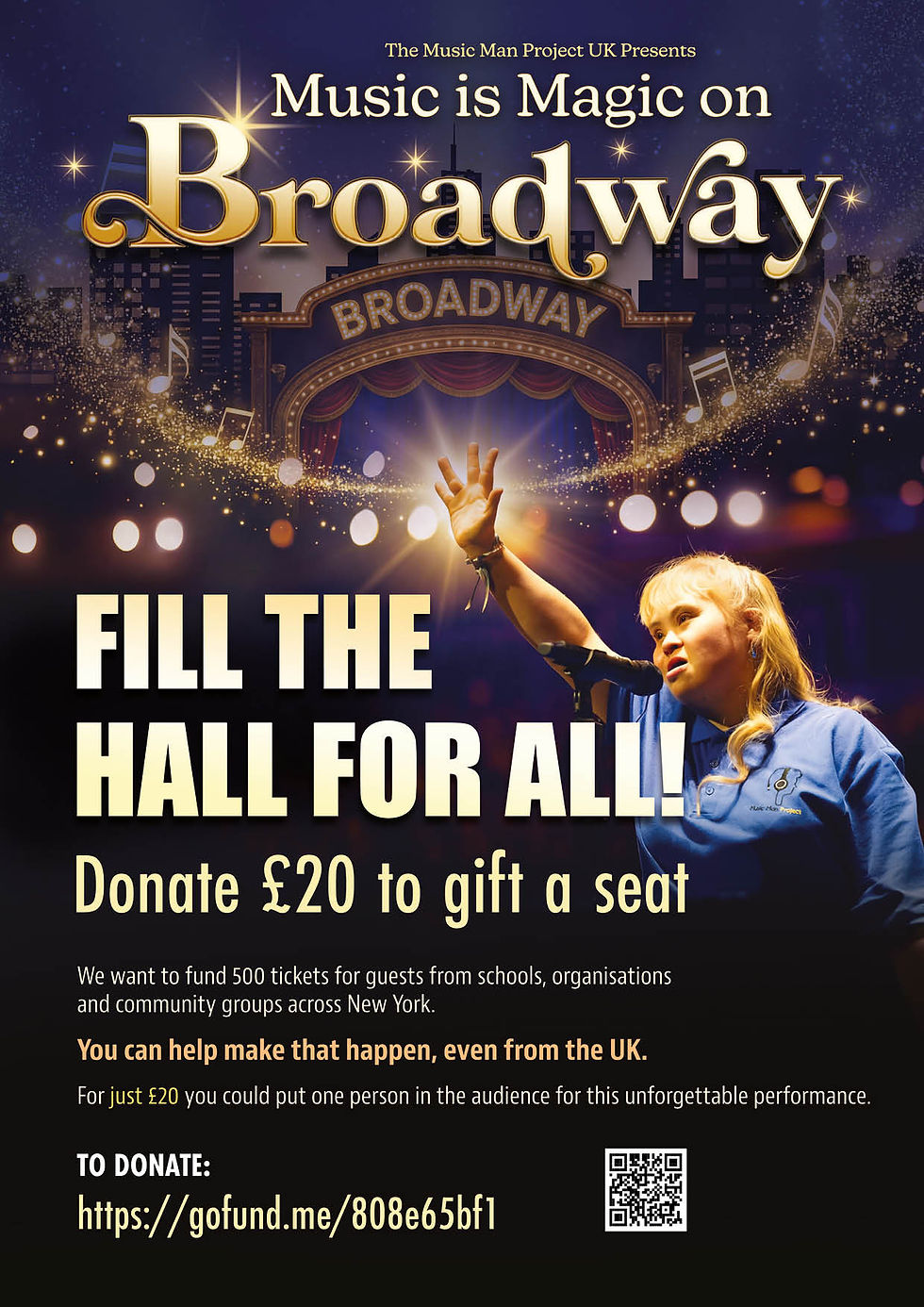
The response was extraordinary. We soon surpassed our initial £10,000 target, and I was thrilled to discover just how strongly people connected with the idea. This was about so much more than filling empty seats.
Our musicians had spent years challenging perceptions of disability, proving that talent, ambition and musical excellence are not determined by a diagnosis. Now, on one of the world's most famous stages, they had the opportunity to become role models for people who might recognise something of themselves in the performers before them.
I wanted our musicians to look out at an audience as diverse as they were. An audience filled with people who understood the barriers they had overcome, families who shared similar experiences, and teachers and carers who might return home inspired to create opportunities of their own.
I wanted people who might never normally have the opportunity to attend a Broadway show to feel that this extraordinary theatre belonged to them too. After all, what better way to honour the history of the legendary Hall for All than to open its doors to those who still face barriers to participation in the arts?
The more I thought about it, the more I realised that what had started as a desperate attempt to sell tickets had become something far more important. We weren't simply trying to find an audience for The Music Man Project. We were creating an audience that The Music Man Project had been created to serve.
I had initially worried about the idea but suddenly, everything made sense. This show was for them.
As successful as our fundraising campaign had been, we still faced one enormous challenge.
How were we actually going to reach the people of New York?
We had hundreds of free tickets to give away, but we needed to connect with the families, carers, teachers and disability communities who would benefit most from them. Our supporters in the UK had done their bit. Now we needed to find our audience on the other side of the Atlantic. And then I had an idea.
Facebook Ads!
With the help of ChatGPT, I ventured into the hitherto mysterious world of paid social media advertising. How difficult could it possibly be?
As it turned out, very!
I spent hours navigating endless screens, trying to understand audiences, locations, budgets, targeting, advertising accounts and all manner of technical jargon. For days, I worked late into the night, determined to master a system that seemed designed to test every ounce of my patience. I was completely out of my depth, but this had never stopped me before!

Eventually, after much trial and error, I had something resembling a campaign ready to launch. A Facebook and Instagram advertisement promoting our free Broadway tickets to people across New York City, supported by a simple online form where families and organisations could request seats. I had even worked out how to distribute the tickets electronically through Ticketmaster transfers - a small technological miracle in itself!
All that remained was to commit some money and hope that somebody, somewhere in New York, would actually see it. I took another deep breath, committed £500 of our precious funds to the advertising campaign and pressed the button.
And waited…
The following morning, I checked my emails. I couldn't believe what I was seeing! Ticket requests were flooding in from across New York. Families, carers, teachers and disability organisations were responding to our invitation to experience The Music Man Project on Broadway.
And the requests just kept coming.
Over the following days and weeks, the numbers steadily increased until I could barely keep up with the demand. I found myself spending every spare moment responding to emails, processing requests and transferring tickets to complete strangers on the other side of the Atlantic.
Even Ticketmaster seemed unable to cope with my newfound success! The system repeatedly blocked me because I was transferring so many tickets to third parties. Having spent months worrying about empty seats, I now had the rather extraordinary problem of trying to give away hundreds of tickets quickly enough! It was exhausting, frustrating and absolutely wonderful.
Finally, We're Going to Broadway!
And then, at long last, the day arrived.
After 18 months of fundraising, months of planning, countless sleepless nights and the terrifying last-minute flight cancellation, we were finally boarding our Virgin Atlantic flight to New York.
As I settled into my seat, the sense of relief was overwhelming. Our 60-strong travelling party was finally on its way, including our 16 extraordinary Global Ambassadors, whose dreams were about to become reality.
The Virgin Atlantic staff were incredible, welcoming our group with such warmth, kindness and enthusiasm. After everything we had been through with the flights, their support meant more than they could possibly have imagined.

Of course, the work hadn't stopped. Ticket requests were still pouring in, and I knew that much of my first few days in New York would be spent locked away in my hotel room, answering emails and arranging Ticketmaster transfers instead of enjoying the sights of Manhattan.
But I didn't care. We were on the plane. Our musicians were on their way to Broadway. And somewhere in New York, hundreds of people were preparing to experience a show that, just a few weeks earlier, they might never have known existed.
For the first time in weeks, I allowed myself to believe that everything might actually be alright. But there was still one final hurdle to overcome.
ESTA–Visa Ping-Pong!
Getting everyone on the plane wasn't the only obstacle. There was the small matter of actually being allowed into the United States! Throughout the planning process, colleagues had repeatedly warned me to check the visa requirements for a large group travelling to America to perform a concert. The implication was that we might be refused entry unless we obtained lengthy and expensive work visas for the entire company.
And so began an exhausting game of ESTA–visa ping-pong!
One set of guidance suggested that we would be fine travelling under the ESTA Visa Waiver Programme. Another raised serious doubts about whether our performances would qualify at all. I sought professional legal advice from several sources, only to discover that we might be fine, we might not be fine, and that any further clarification could cost an eye-watering amount of money!
As someone who responds to hundreds of emails every day, I began to wonder whether I had chosen the wrong profession. If I were a lawyer, I could apparently charge thousands for my pearls of wisdom!
Ultimately, despite all my research, it seemed that everything could come down to the discretion of the US border officers. I made the decision to proceed.
Determined to be prepared for every eventuality, I produced a 25-page ESTA Evidence Pack, explaining the charitable nature of our visit, our performers, our arrangements and the purpose of our concerts. Sadly, a couple of our professional musicians who had been due to play in the band withdrew because of concerns about the visa requirements.
By the time we landed in New York, I felt reassured by the advice I had received and the evidence I had assembled. Nevertheless, as we approached passport control, my stomach was in knots. What if an immigration officer took a different view? What if we were refused entry after everything we had been through? It was almost too awful to contemplate.
Thankfully, everything seemed to be going smoothly.
Until Daniel.
Daniel, our wonderful Music Man Project drummer and the only member of our travelling party who uses a wheelchair, was suddenly pulled aside and directed to a separate room for further questioning. I immediately joined him and his mum, clutching my precious ESTA Evidence Pack as we made our way into a room containing around 50 people, surrounded by armed officers.
Daniel was distraught.
"I've not done anything wrong, Mum," he cried.
It was heartbreaking. Of all the people in our group, the only person facing additional questioning was a young man with learning disabilities who used a wheelchair.
Pushing Daniel, I confidently made my way past the queue and approached the desk.
"We will need to fast-track this, sir," I announced.
No response.
"Sir, this young man has learning disabilities. We really need to fast-track this, please."
The officer finally looked up.
"I hear you."
A few moments later, he casually handed Daniel his passport and sent us on our way.
Just like that. After months of worrying, researching, seeking advice and preparing 25 pages of supporting evidence, our entire group had made it through immigration.
We were in New York!
And as for my extensive research into American immigration requirements?
I won't even charge you for the advice!
To be continued in Part 2…


Comments